
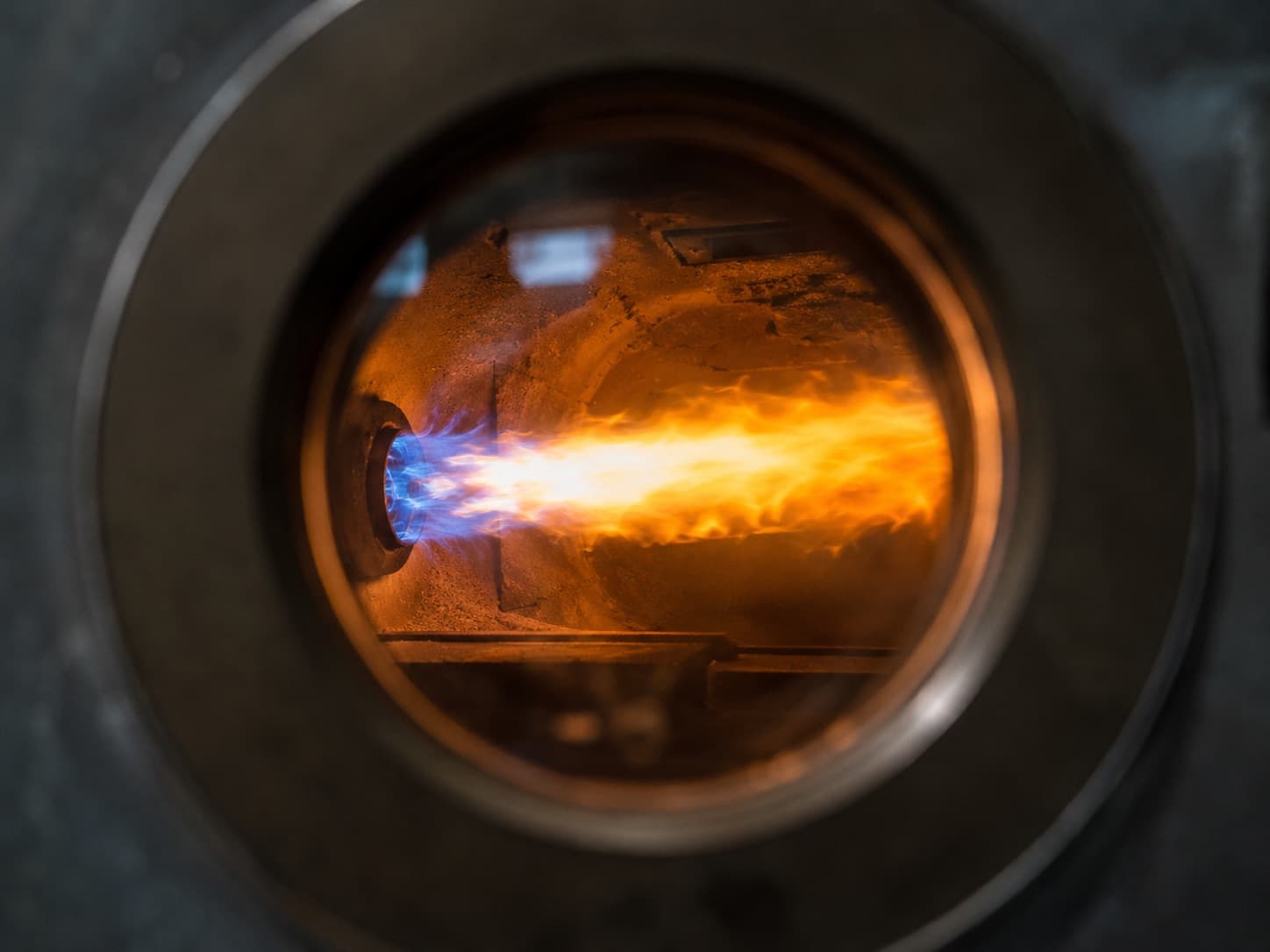
Flue gas analysis measures a burner's fuel–air ratio directly, establishing combustion efficiency and quantifying fuel waste that would otherwise go unnoticed. As a general rule, every 3 percentage points of excess oxygen (O₂) above target corresponds to roughly 1% of wasted fuel. In Türkiye, installations above 30 kW on gas are required by the Regulation on Control of Air Pollution from Heating to have this measurement carried out once a year, by law.
What is flue gas analysis, and what does it measure?
The proportions of oxygen, carbon dioxide and carbon monoxide in the flue gas tell you exactly how efficiently a burner is firing at that moment. A calibrated electrochemical analyser samples these gases through a probe placed in the burner's flue outlet and converts the readings into an efficiency percentage.
The measurement establishes two things simultaneously:
- Is combustion complete? The presence of CO indicates the fuel is not fully combusting — which means both wasted fuel and a poisoning risk.
- How much excess air is present? More air than necessary carries heat straight up the flue without transferring it.
The optimum sits between the two — too little air produces CO, too much air throws heat away.
Why this is a legal requirement
As covered in our maintenance frequency guide, Article 17 of the Turkish Regulation on Control of Air Pollution from Heating requires installations above 30 kW (gas) or 15 kW (liquid/solid fuel) to have flue gas measurement carried out annually, alongside maintenance and flue cleaning, by an authorised person or company. This is not a formality — it is the only method that reliably detects both efficiency loss and CO risk.
The 5 parameters measured, and what they mean
| Parameter | What it shows | High reading means | Low reading means |
|---|---|---|---|
| O₂ (oxygen) | Excess air not participating in combustion | High excess air, high stack loss | Insufficient air, CO risk |
| CO₂ (carbon dioxide) | How close combustion is to complete | Close to efficient combustion (each fuel has a ceiling value) | Excess air or incomplete combustion |
| CO (carbon monoxide) | Incomplete combustion and poisoning risk | Dangerous — the burner should be shut down | Normal, target condition |
| Flue gas temperature | Heat being lost up the stack | Fouled heat exchanger or over-firing | Good heat transfer |
| Draught / flue pressure | Whether the flue is clearing gases correctly | Excessive draught raises heat loss | Insufficient draught, flashback risk |
How the excess air ratio (λ) is calculated
The measured O₂ value converts to the excess air ratio (lambda, λ) with the formula:
λ = 21 / (21 − O₂)
| Measured O₂ | λ (approximate) | Interpretation |
|---|---|---|
| 0% | 1.00 | Theoretical (stoichiometric) combustion — not a practical target |
| 3% | 1.17 | Tightly tuned, efficient combustion |
| 5% | 1.31 | Typical upper bound of the target range for natural gas |
| 8% | 1.62 | Noticeable excess air — waste has begun |
| 10%+ | 1.90+ | Significant efficiency loss, the setting needs urgent review |
The closer λ is to 1, the less excess air the burner is using. But pushing λ too close to 1 increases CO risk — the target is therefore a range that leaves a safety margin (typically λ ≈ 1.15–1.30 for natural gas), not zero.
Theoretical maximum CO₂ by fuel
Each fuel's chemical composition sets a ceiling on the CO₂ it can produce at complete combustion. This ceiling applies at zero excess air (λ = 1) and is never fully reached in practice — how close the measured CO₂ sits to this ceiling indicates how efficient combustion is.
| Fuel | Theoretical maximum CO₂ |
|---|---|
| Natural gas | ~11.7 – 11.8% |
| LPG (propane) | ~13.7% |
| Gas oil (light fuel oil) | ~15.4% |
These are universal combustion chemistry constants, not country-specific figures; they are the standard reference values used throughout the international combustion engineering literature.
How stack loss is calculated
Heat lost up the flue (stack loss, qA) depends fundamentally on two things: the difference between flue gas temperature and ambient temperature, and the measured O₂ or CO₂ value. Modern flue gas analysers calculate this automatically, using a method based on the Siegert formula, and display it directly as an efficiency percentage; the coefficients vary by fuel type and are built into the analyser.
The concept to hold onto is simple: the bigger the temperature difference, the bigger the loss. A flue gas temperature of 220°C against a 20°C ambient gives a 200°C difference — a typical sign of a fouled heat exchanger or an over-firing burner. On a healthy system this difference typically sits in the 120–180°C range, depending on boiler type.
How efficiency loss becomes fuel cost
Two rules of thumb widely used in combustion engineering translate a measurement result directly into savings potential:
- The O₂ rule: roughly every 3-percentage-point reduction in excess oxygen corresponds to around a 1% gain in efficiency.
- The temperature rule: roughly every 22°C (40°F) reduction in flue gas temperature also corresponds to around a 1% gain in efficiency.
Example (provided only to illustrate the calculation logic — not data from an actual site): if a plant room's measured O₂ is 11% against a target of 5%, that is roughly 6 percentage points of excess oxygen, corresponding to a rough estimate of around 2% additional fuel consumption. On a site with a high annual gas bill, that alone can represent a meaningful cost driven purely by a mistuned burner.
The actual saving is site-specific — it depends on boiler type, load profile and how far the current setting has drifted from target. The precise figure can only be established by measurement.
CO: invisible, but the most critical parameter
CO looks like just another row in the efficiency table, but it sits in a category of its own, because it carries a direct safety risk. The thresholds generally accepted in industry practice are:
| CO level (air-free corrected) | Assessment |
|---|---|
| < 100 ppm | Target range, normal |
| 100–400 ppm | Should be investigated if trending upward |
| > 400 ppm | Unacceptable — shut the burner down and call for emergency service |
If CO is rising and unstable during a measurement, treat it seriously even if the absolute value is still low — this is an early sign of a rapidly deteriorating combustion problem.
How often should flue gas analysis be carried out?
The legal minimum in Türkiye is once a year, but because this measurement is a standard part of scheduled burner maintenance, it is best carried out at the interval recommended by site type in our maintenance frequency guide. On hotels, hospitals and industrial sites, repeating the measurement every 3–6 months catches seasonal gas pressure changes and gradual fouling early.
Frequently Asked Questions
What is flue gas analysis?
Flue gas analysis is a measurement method that uses a calibrated instrument to read O₂, CO₂, CO and gas temperature at the burner's flue outlet, establishing combustion efficiency and quantifying fuel waste in numerical terms.
Is flue gas analysis a legal requirement?
Yes, in Türkiye. Installations above 30 kW on gas, or 15 kW on liquid/solid fuel, must have flue gas measurement carried out once a year by an authorised person or company, under the Regulation on Control of Air Pollution from Heating.
Why does the O₂ level in flue gas matter?
The O₂ level indicates how much excess air is not participating in combustion. Excess air carries part of the generated heat straight up the flue without transferring it — which is direct fuel waste.
What does a high CO reading mean?
A high CO reading indicates the fuel is not combusting completely. This carries both an efficiency loss and a poisoning risk. If CO (air-free corrected) exceeds 400 ppm, the burner should be shut down and emergency service called.
How much fuel can flue gas analysis save?
The exact figure is site-specific, but a widely used rule of thumb is that every 3-percentage-point reduction in excess oxygen corresponds to roughly a 1% efficiency gain. On a poorly tuned system, that can add up to a meaningful annual cost. ---
About Beray Enerji
Beray Enerji is an Istanbul-based burner service company operating across Türkiye, with primary coverage in the Marmara, Thrace and Aegean regions. We provide calibrated flue gas measurement, combustion setting, scheduled maintenance and fault response for gas, oil and dual-fuel burners of all makes and models, backed by a technical team with 30 years of field experience. To arrange a measurement, contact us on +90 (000) 000 00 00 or at info@berayenerji.com.
Related services: Burner maintenance · Burner repair service · Contact
References
- Regulation on Control of Air Pollution from Heating (Türkiye), Article 17
- EN 676 — Automatic forced draught burners for gaseous fuels
- Combustion engineering literature — fuel-specific theoretical maximum CO₂ values (standard international reference figures)
- U.S. Department of Energy (DOE/EERE) industrial process heating efficiency guidance — excess air and efficiency relationship
- Calibrated flue gas analyser manufacturer documentation (Siegert formula coefficients)